How to Launch a Protein Powder Brand in 2026: 6 New Rules
Read the transcript
Launching a protein brand in 2026? The rules changed. The demand is there: high protein is America’s #1 diet, four years running. Rule 1: start simple. Our Formula Helper drafts a spec sheet in seconds. Rule 2: test small. Start with a first run you can sell, then scale up. Rule 3: your brand does the selling. 71% of supplement users say they stick with their brand. Rule 4: get found where people shop. AI shopping traffic is up nearly 400%. Rule 5: prove your quality. TikTok Shop and Amazon now ask for lab tests. Rule 6: know your costs. Whey isolate more than doubled, and it’s still near its peak. So compare quotes from verified manufacturers before you commit. Get free quotes at SupplementQuotes.com.
Protein demand is at a record: 70% of US adults say they actively try to include protein in their diet, and high protein has been the most-followed diet four years running. To launch a protein powder brand in 2026, start with a simple formula you can make in weeks, test with a first run you can sell through, build a brand people come back to, get found through AI assistants and TikTok Shop, prove your quality with lab tests, and price for whey isolate costs that are still near their peak.
There has never been more demand for protein. Seven in ten American adults say they actively try to include it in their diet, and “high protein” has been the country’s most-followed diet four years running. There have also never been more ways for a new brand to get found, or more ways to get it wrong. Here is what changed in 2026, and the six rules we would follow to launch a protein powder brand this year.
- Start with a simple formula you can make in weeks, then refine it.
- Test with a first run you can sell through before you scale up.
- Customers come back for a brand, not a spec sheet.
- Shoppers now find products through AI assistants and TikTok Shop.
- Lab tests are now the price of entry on the biggest platforms.
- Whey isolate prices are still near their peak, so compare quotes before you commit.
Why 2026 is a big year for protein
Protein has moved from the gym into everyday food. Starbucks made protein lattes and protein cold foam a permanent part of its US menu in September 2025, and the average US supermarket now carries 38,708 products with a protein claim, according to NielsenIQ data reported by the AP.
Interest is still climbing. Half of US adults say they are trying to eat more protein, up eight points in a year, including 54% of women (Circana, October 2026). Among Gen Z and Millennials, 65% say they are actively trying to get more protein (The New Consumer, 2026). The new Dietary Guidelines for Americans, released January 7, 2026, tell people to prioritize protein at every meal. The guidelines are about protein foods, not powders, but they keep protein in the headlines.
Weight-loss drugs are part of the story too. About one in eight US adults say they currently take a GLP-1 medication (KFF, November 2025), and 65% of GLP-1 users say they are looking for more protein (Circana, August 2026).
Inside the category, the money is moving. Whey made up 43.3% of protein powder sales and grew 13.5% in 2025, while plant-based powders fell 6%. Ready-to-drink protein reached $7.6 billion, and clear protein shakes grew 34%, faster than any other type (SPINS).
Start simple, then refine
The most common way to lose a year is chasing a perfect formula. A protein powder with a short ingredient list, one great flavor and an honest protein number can be made in weeks. A fully custom formula takes months, and the market keeps moving while you wait.
| Path | First order | Typical minimum | Best for |
|---|---|---|---|
| Stock formula (private label) | About 3 to 6 weeks | From about 500 units | Testing the market fast |
| Custom formula | About 8 to 18 weeks | Often 1,500 units or more | A formula you own |
Typical ranges published by US contract manufacturers in 2024 to 2026. Your quotes will vary with the formula, the packaging and the testing you ask for.
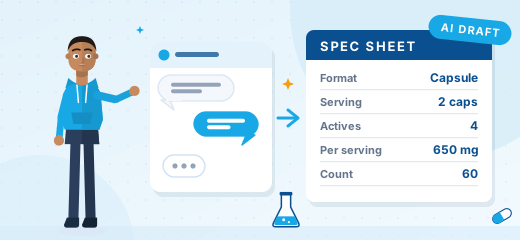
Starting from an idea? Our Formula Helper turns a plain description into a draft spec sheet in seconds: the format, the serving size, each ingredient with an amount per serving, and a suggested minimum order. Edit it, then send it straight into a quote request.
Simple does not mean careless. Choose a protein source you can afford to keep buying, pick one hero flavor, and make sure the protein per scoop on your label is real protein. Rule 5 explains why that matters.
Test small before you scale
Most new products do not take off. NielsenIQ says just half of new products keep growing in their second year. The good news is that you can tell early: NielsenIQ found that growing and non-growing launches separate as early as week four, even though 67% of marketers wait 12 to 15 weeks to judge.
That makes your first run the biggest bet you place. A run you cannot sell is cash sitting on a pallet. One finance firm’s example: if you sell 800 units a month, a 10,000-unit minimum is about a year of stock. Choose a first run you can sell through well inside your shelf life.
Packaging changes the math. Tubs and pouches often start at a few thousand units, while single-serve stick packs can need 30,000 or more. Start in a tub, learn what sells, then add stick packs.
Launch is the start, not the finish. Circana found that more than 30% of a product’s trial builds in its second year and later, and it describes online selling as a place for low-risk testing and fast iteration.
Your brand does the selling
Two whey isolates can look almost identical on a spec sheet. What customers come back for is the brand: the taste, the story, the community and the sense that you understand them. In CRN’s 2024 consumer survey, 71% of US supplement users said they are loyal to their chosen brands, and SPINS data shows about three in four protein buyers buy again.
The biggest recent wins near protein were brand stories first. David Protein, a protein bar brand, expects more than $300 million in sales in 2026, up from zero in 2024, and the company that owns it was valued at $2.25 billion in September 2026. Celsius paid $1.8 billion in 2025 for Alani Nu, a wellness brand best known for energy drinks, founded in 2018 by an entrepreneur and influencer. Those are outliers, but the lesson scales down: a clear customer and a clear voice beat a longer ingredient list.
Plan for the second order, not just the first. Subscriptions help, but they are not automatic. Across about 1,800 supplement brands on one subscription platform, 86.6% of subscribers placed a second order, but only 33.8% reached a fourth (Recharge data). Give people a reason to stay.
Get found where people shop now
More shoppers ask AI before they buy. Adobe found that AI-referred traffic to US retail sites grew 393% year over year in the first quarter of 2026, and in March those visitors converted 42% better than other traffic. In Adobe’s survey, 39% of US consumers had used an AI assistant to shop. Circana found that 34% of consumers use AI to explore new products, and 25% have bought something an AI recommended.
That changes what your product page needs. Adobe also found that a large share of retail page content is not fully readable by AI, and product pages scored lowest. Put your Supplement Facts, protein per serving, flavor and testing details on the page as plain text, not only in images, and answer the questions people actually ask.
Social commerce is the other new front door. Supplements are TikTok Shop’s top health and beauty category, with $784 million in sales in the year to February 2026, and supplement sales there grew 71% in a year (NielsenIQ). TikTok Shop became the number four US health and beauty online retailer in under three years. You do not need a celebrity: about 55% of Built Bar’s TikTok Shop units came from creators with 10,000 to 50,000 followers (FastMoss).
Online is about to be the biggest channel of all. E-commerce made up 24.3% of US supplement sales in 2025 and grew faster than any other channel, and Nutrition Business Journal now expects it to become the number one channel in 2026.
Prove your quality
Protein powder had a hard year for trust. In October 2025, Consumer Reports tested 23 protein powders and shakes and found that more than two-thirds had more lead in a single serving than its daily level of concern. That level is based on California’s Proposition 65 limit of 0.5 micrograms a day, which is much stricter than the FDA’s reference levels for lead from food, and the industry group CRN points out that no regulator recognizes it as a safety limit. Plant-based products averaged about nine times the lead of dairy-based ones. Every product did contain the protein its label claimed, and a later batch of five chocolate powders all met Consumer Reports’ threshold.
Regulators and platforms noticed. Texas opened an industry-wide investigation of protein powder makers in June 2026. To sell supplements on TikTok Shop you need an invitation, your factory’s FDA registration and cGMP certificate, and recent lab reports covering microbes, heavy metals and potency. Amazon requires third-party verification for supplements, and since March 31, 2026 listings that do not match the Supplement Facts panel face removal.
Here is what that means for you. The FDA does not approve supplements before they are sold, and a factory’s FDA registration number is not an approval. Under the federal cGMP rule, your manufacturer must set specifications, including limits on contamination, and test against them, but the rule does not set a number for heavy metals. Your specifications, and the tests you ask for, set the standard.
- Ask for a certificate of analysis on every lot, with heavy metal results.
- Count real protein. Protein is calculated from nitrogen, so cheap amino acids can inflate the number on the label, a practice known as protein spiking. Ask your manufacturer how it tests protein content.
- Consider third-party certification, such as NSF or USP, especially if you plan to sell on Amazon or to athletes.
- Keep reviews and influencer posts honest. The FTC rule against fake reviews, including AI-written ones, has applied since October 2024, and in December 2025 the agency warned companies about penalties of up to $53,088 per violation.
Know your costs
Whey is a byproduct of cheese: making one pound of cheese leaves about nine pounds of liquid whey. Turning that whey into concentrate and isolate takes filtration capacity, and in 2026 demand outran it. Here is how prices moved:
| When | Whey concentrate (WPC80) | Whey isolate (WPI) |
|---|---|---|
| Early October 2025 | About $5 a pound | Not quoted |
| Late June 2026 | $12.50 to $13.00 a pound | $13.50 to $14.00 a pound |
| Mid-October 2026 | Mostly in the $9s a pound | Mostly in the $14s a pound |
Ever.Ag market estimate (October 2025) and USDA Dairy Market News commentary (June 25 and October 16, 2026). These are bulk ingredient prices, not what you pay per tub.
Concentrate has eased since its summer peak, but isolate is still near its high. Relief is coming slowly: new isolate capacity is being built, including a New Mexico plant adding about 10 million pounds of isolate by 2027, while US cheese production grew just 1.4% in August 2026.
Switching to plant protein is not a free pass. Since 2024 the US has charged anti-dumping duties of 122% to 280% on pea protein from China, on top of countervailing duties, and pea protein isolate cost about $4.00 a pound in North America in February 2026, against $1.60 in China. Most brands that reformulate stay within dairy, blending in milk protein, casein or egg, and those prices have started rising too.
Shelf prices lag behind. SPINS says ingredient cost increases usually take 12 to 18 months to reach store shelves. Retail prices for whey concentrate powders were already up about 15% year over year by June 2026 (Datasembly, via the AP), and the company behind Optimum Nutrition raised prices 7.6% in the first half of 2026.
So price your product with room to spare, and do not lock in on one number. Get quotes on the same spec from several manufacturers, ask for a quote on a blend as well as straight whey, and ask how long each price holds.
Ready to launch?
2026 rewards protein brands that move fast, start small, build a real brand, show up where shoppers search, prove their quality and know their numbers. The demand is there for the brands that do.
Protein powders are open for free quotes on SupplementQuotes now. Describe your product once, and verified manufacturers quote on the same spec, side by side. Starting from an idea? Begin with the Formula Helper.
Sources
- IFIC, 2026 Food & Health Survey release (October 7, 2026)
- IFIC, 2026 Food & Health Survey: nutrition findings (2026)
- Circana, insights from the Wellbeing report (October 22, 2026)
- Circana, Eating Patterns in America (August 19, 2026)
- The New Consumer and Coefficient Capital, Consumer Trends 2026 (March 2026)
- FoodNavigator, How protein is shaping active nutrition in 2026 (SPINS data) (March 15, 2026)
- New Hope Network, Protein power play (SPINS data) (June 8, 2026)
- New Hope Network, Consumer demand drives whey protein shortage, price increases (May 11, 2026)
- USDA and HHS, Dietary Guidelines for Americans 2025–2030 (January 7, 2026)
- Starbucks, new protein lattes and cold foam drinks (September 29, 2025)
- KFF poll on GLP-1 use (November 14, 2025)
- Euromonitor International, Wellness trends and GLP-1s fuel protein market (July 14, 2026)
- AP via Fortune, whey protein prices and demand (June 14, 2026)
- Adobe, AI traffic to retail sites (April 16, 2026)
- Circana, 2025 New Product Pacesetters (May 21, 2026)
- NutraIngredients, TikTok Shop’s largest health and beauty category is supplements (June 23, 2026)
- NielsenIQ, How TikTok Shop is reshaping beauty e-commerce in the US (March 31, 2026)
- Nutraceuticals World, US supplement sales hit $72.88 billion (NBJ and NielsenIQ data) (March 16, 2026)
- New Hope Network, E-commerce poised to become the top sales channel for supplements (July 14, 2026)
- FastMoss, The TikTok Shop protein bar playbook (June 27, 2026)
- Consumer Reports, Protein powders and shakes contain high levels of lead (October 14, 2025; updated January 8, 2026)
- CRN, statement on Consumer Reports protein powder testing (October 15, 2025)
- Texas Attorney General, industry-wide protein powder investigation (June 8, 2026)
- TikTok Shop Seller University, dietary supplement requirements (viewed October 2026)
- NutraIngredients, Amazon expands its third-party cGMP requirement to all supplements (December 22, 2025)
- PPC Land, Amazon’s Supplement Facts listing deadline (January 14, 2026)
- FDA, Questions and answers on dietary supplements (current 2026)
- 21 CFR 111.70, dietary supplement specifications (eCFR via Cornell LII)
- CRN, guidelines for labeling protein in dietary supplements (2014)
- FTC, warnings under the consumer review rule (December 22, 2025)
- USDA Dairy Market News, weekly report (October 16, 2026)
- USDA Dairy Market News, dry products report (archived copy) (June 25, 2026)
- Ever.Ag, Chart Chatter (October 2025)
- USDA NASS, Dairy Products (October 5, 2026)
- USDA ARS, C.W. Robbins, Whey (1995)
- DairyReporter, Whey protein shortage drives major global investments (January 16, 2026)
- Irish Farmers Journal, Glanbia invests in whey production capacity (November 19, 2025)
- International Trade Administration, duties on pea protein from China (June 28, 2024)
- Expana, Plant-Based Protein Report (March 2026)
- Vesper, Protein blends challenge whey’s grip on sports nutrition (August 21, 2026)
- Glanbia, half-year 2026 results (August 6, 2026)
- NielsenIQ, Innovation essentials for emerging brands (August 27, 2025)
- NielsenIQ, the strategies behind 2025’s top-performing innovations (December 9, 2025)
- The Shelby Report, Circana: AI and social media reshape discovery (June 24, 2026)
- Eightx, Inventory planning for supplement brands (June 22, 2026)
- CRN, 2024 Consumer Survey on Dietary Supplements (October 29, 2024)
- AgFunderNews, David Protein owner hits $2.25 billion valuation (September 3, 2026)
- Celsius Holdings, agreement to acquire Alani Nu (SEC filing) (February 20, 2025)
- eCommerce Fastlane, supplement subscription reorder data from Recharge (July 7, 2026)
Submit your product once and receive competing quotes from verified supplement manufacturers, free for brands and NDA-protected.