How to Start a Supplement Brand: From Idea to First Pallet

Start with one product and the customer it is for, then decide between private label, which launches fastest and cheapest, and a custom formula, which is the one you own. You do not need to source ingredients; you need a spec sheet a manufacturer can quote. The first production run is the real launch cost, typically $3,000 to $15,000 for a capsule product, and the FDA holds your brand responsible for the product even though you did not make it.
Most people who decide to start a supplement brand register an LLC, buy the domain and spend three weeks on a logo. Then they email a manufacturer, get asked "what is your spec?" and have no answer. This guide is that answer, in the order the decisions actually come.
- Pick one product and the customer it is for before you spend a dollar on branding.
- Private label launches fastest and cheapest; a custom formula is the one you own.
- You do not need to source ingredients. You need a spec sheet a manufacturer can quote.
- The FDA does not approve supplements, but it does hold your brand responsible for them.
- Your first production run is the launch cost. Everything else is small next to it.
Start with the product, not the company
The company paperwork is the easy part, and none of it tells you whether the business works. The decision that matters first is what you are going to sell and to whom, because that decision sets your formula, your manufacturer, your minimum order and your launch budget.
Pick one product for launch. Brands that try to launch a line of six products at once split their budget six ways and end up with six small, expensive runs. One product at a real production quantity costs less per unit, is easier to sell, and tells you quickly whether the idea has customers.
The products first brands launch most
Some categories are launched far more often than others because demand is proven and the manufacturing is routine. If you do not already have a specific product in mind, these are the ones a first brand usually picks from:
- Multivitamins and daily basics. Broad demand, mature formulas, plenty of manufacturers. Hard to differentiate on ingredients, so the brand and the audience do the work.
- Protein and nutrition powders. Whey, plant protein, meal replacements. Higher order volumes and heavier freight, but a large, repeat-buying customer base.
- Probiotics and gut health. Strong demand, but strain selection, potency at expiry and storage all need a manufacturer who does this regularly.
- Sleep, stress and magnesium. Simple formulas, low ingredient cost, and a customer who reorders monthly.
- Greens and superfood blends. Powder format, easy to brand, and a natural fit for subscriptions.
- Pre-workout and sports nutrition. Flavor and format matter as much as the formula. Competitive, so new brands target a niche rather than everyone who lifts.
- Collagen and beauty. Powders, capsules and gummies. Sourcing (bovine, marine) and claims both need care.
- Gummies. Not a category so much as a format that lifts almost any category. Higher minimums and unit cost than capsules, and not every manufacturer makes them.
Pick the category, then pick the niche inside it. "A magnesium supplement" competes with everyone. "A magnesium supplement for people who train in the evening and cannot sleep afterwards" has a customer you can find.
Private label, white label or custom formula
These three terms get used loosely, and the difference decides most of your launch cost and timeline.
- Private label. The manufacturer already makes the product. You choose it from their catalog, put your brand on the label, and order. Fastest and cheapest way to launch, because the formula is proven, the ingredients are stocked and there is no development work. The trade-off is that other brands can sell the same product.
- White label. In the supplement industry this usually means the same thing as private label: a stock product sold under your name. Some people use it for a formula the manufacturer built for a group of brands to share. Ask what the manufacturer means when they say it.
- Custom formula. Your ingredients, your doses, your product. Nobody else has it, and you own it. It costs more and takes longer, because the manufacturer has to source your ingredients, confirm the blend can be made at the doses you want, and test something new.
| Private label | Custom formula | |
|---|---|---|
| Time to first quote | Days | Days, once the spec is written |
| Time to product in hand | 6 to 10 weeks | 10 to 16 weeks |
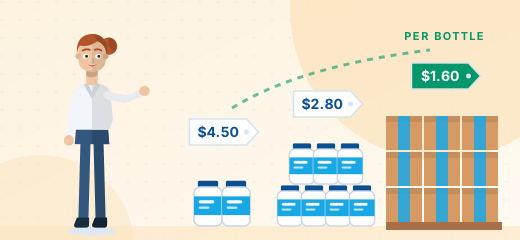
| Typical minimum | Lower, often 500 to 1,000 units | Higher, often 2,500 units and up |
| Who else can sell it | Any brand the manufacturer supplies | Nobody |
| Development work | None | Sourcing, blend confirmation, testing |
| Best for | Testing a market, launching fast | A product you want to build a brand on |
A common path is to launch private label to learn the market, then move to a custom formula once you know what your customers want. Both routes go through the same kind of manufacturer, and both can be quoted on SupplementQuotes.
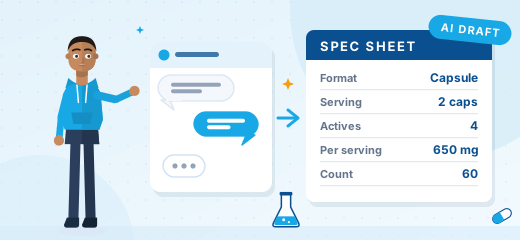
If you want a custom formula and have never written one, the Formula Helper drafts a starting spec from a plain description of the product. It is a first draft, not a reviewed formula, and your manufacturer will see that it started as one. The point is to get you from "I have an idea" to "I have a spec sheet I can send out" in a few minutes.
How to write a formula when you have never written one
You do not need a chemistry degree. You need to make five decisions, because a manufacturer cannot quote until you have:
- 1. The active ingredients and why. What does the product do, and which ingredients are there to do it? Start with ingredients that have published research at the dose you plan to use.
- 2. The doses. Match the amount in the studies, not the amount that fits cheaply in a capsule. Underdosed products are the most common first-brand mistake, and reviewers notice.
- 3. The format. Capsule, tablet, powder, gummy, softgel or liquid. The format sets the manufacturer, the minimum order and a large share of the cost. The formats guide walks through each one.
- 4. Serving size and servings per container. Two capsules a day for thirty days is sixty capsules. That number, times your order quantity, is what you are buying.
- 5. What it must not contain. Allergens, gelatin, gluten, artificial colors, GMO ingredients. Every restriction narrows the ingredient list and the manufacturer list, so decide early.
Where the ingredients come from
New founders often assume they need to find and buy raw ingredients themselves. For a first brand, you almost never do. Contract manufacturers source ingredients through suppliers they have already qualified, with a certificate of analysis on every lot, and that sourcing is built into their quote.
Where sourcing does become your decision is branded ingredients: trademarked forms of an ingredient (a specific patented extract, a named probiotic strain, a branded mineral chelate) that let you put a logo and a study on your label. You specify the branded ingredient; the manufacturer buys it. Expect it to cost more than the generic form, and expect it to be worth it when the study behind it is the reason someone buys your product.
How to find a manufacturer you can trust
This is the step most guides skip past, and it is the one that decides whether your launch becomes a product or a story about a deposit you never saw again. What to look for:
- cGMP compliance under 21 CFR Part 111. The FDA regulation that governs supplement manufacturing. It is the floor, not a feature. Ask for the certificate from the third-party auditor (NSF, UL and SQF all audit facilities against it).
- FDA facility registration. Every facility that manufactures supplements for sale in the US must be registered. Ask for the registration number.
- Experience with your format and category. A capsule house may not make gummies. A sports nutrition facility may never have run a probiotic. Ask what they make most.
- Testing they do as standard. Identity, purity, microbial and heavy metals on incoming ingredients and finished product should be routine. Ask what is included and what costs extra.
- Minimums that fit your budget. Ask for the MOQ up front, in units and in dollars.
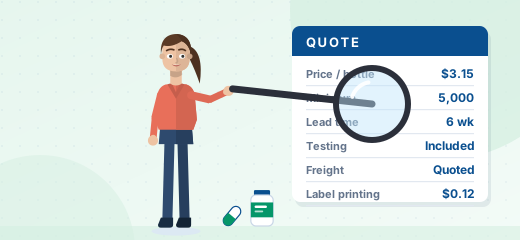
- Written quotes, itemized. Unit price, MOQ, lead time, testing, packaging, label printing and freight, each on its own line. A quote that is one number is not a quote.
Our guide to finding a GMP-certified manufacturer goes through each of these in detail, and the certifications guide explains what each stamp actually certifies. On SupplementQuotes, every manufacturer has passed identity, facility registration and cGMP verification before they can see a request, and the verification file is kept on record.
The FDA rules that apply to you
Dietary supplements are regulated by the FDA as a category of food, not as drugs. That means no pre-approval, but it does not mean no rules. The ones that apply to you as a brand owner, in plain terms:
- Your label has to follow the format. A Supplement Facts panel, the ingredient list in the required order, the net quantity, your business name and address, and the required statements. The rules are in 21 CFR Part 101; the FDA’s labeling guide walks through them. Your manufacturer will review artwork against them, but the label is legally yours.
- Your claims have to stay in bounds. You can say what a product does for normal body structure or function ("supports restful sleep"). You cannot say it treats, cures, prevents or diagnoses a disease. Structure/function claims carry the standard FDA disclaimer on the label, and you notify the FDA within 30 days of first marketing them.
- New ingredients need a notification. An ingredient not sold in the US before October 15, 1994 is a New Dietary Ingredient and needs a notification to the FDA 75 days before you sell it. Most first brands use established ingredients and never touch this. Ask your manufacturer if you are unsure.
- You are responsible for the product even though you did not make it. The FDA treats the brand on the label as responsible for the product’s compliance with cGMP, which is why choosing a compliant manufacturer is a legal question and not only a quality one. Keep the certificates, the CoAs and the batch records.
- Serious adverse events must be reported. If a consumer reports a serious adverse event, you have 15 business days to report it to the FDA. Your label must carry a US address or phone number for those reports.
This is a summary for orientation, not legal advice. A regulatory consultant reviewing your first label before it prints is one of the cheapest insurance policies in this business.
What it costs to start
The single largest launch cost is your first production run, and it is set by the manufacturer’s minimum order. Everything else is small next to it. Orientation figures for a capsule product, so you can see the whole picture at once:
| Line item | Typical range | Notes |
|---|---|---|
| First production run | $3,000 to $15,000 | 1,000 bottles of a private label capsule at $3 to $5 each sits at the low end; a custom formula at a 2,500-unit minimum at the high end |
| Packaging | $0.80 to $1.50 per bottle | Bottle, lid and label. Often quoted inside the unit price; confirm |
| Label design | $300 to $1,500 | Freelance to agency. Yours to source |
| Regulatory label review | $300 to $800 | Prevents reprinting the entire first run |
| Product liability insurance | $500 to $1,500 per year | Most retailers and marketplaces require it |
| Third-party testing | $100 to $500 per test | Only if you want more than the manufacturer’s standard program |
| Storefront | $40 to $100 per month | Shopify or similar, plus a domain |
Those are ranges, not quotes; your formula is the price. For the per-unit breakdown by format, see what it costs to manufacture supplements and the manufacturing guide. Contract manufacturing is what makes a supplement brand possible without a factory: you are paying for one production run, not for equipment, a facility or a quality team.
Where to sell it
Your own store first, marketplaces second. A store you own (Shopify, WooCommerce and BigCommerce are the common choices) gives you the customer relationship, the subscription and the margin. Amazon gives you traffic but takes a cut and holds supplements to its own compliance requirements, including lab testing and documentation you will need your manufacturer’s help to produce.
Whichever platform you choose, check its restricted products policy before you build a formula around an ingredient. Some ingredients that are legal to sell are still not allowed on specific platforms or through specific payment processors.
Five ways a first run goes wrong
- Underdosing to hit a price. The product does nothing, the reviews say so, and the second run never happens.
- Launching six products at once. Six small runs at six high unit costs, and no budget left to sell any of them.
- Skipping the label review. The label prints, a claim or a panel is wrong, and the whole run is relabeled or scrapped.
- Choosing a manufacturer on price alone. The cheapest quote is often the one with the least testing and the fewest answers.
- Picking gummies as a first product. Higher minimums, higher unit cost, fewer manufacturers, and a format that is unforgiving in heat.
The timeline, week by week
Every brand is different, but a first launch that goes smoothly looks roughly like this:
| When | What happens | Your job |
|---|---|---|
| Week 0 | Product and customer chosen | Pick one product. Write down who it is for |
| Week 1 | Spec sheet written | Five decisions on paper, or a Formula Helper draft refined |
| Week 1 to 2 | Quotes arrive | Compare unit price, MOQ, lead time and testing on the same spec. Three quotes minimum |
| Week 2 to 3 | Quote accepted, deposit paid | Business entity, bank account and insurance in place. Half up front is the industry standard |
| Week 3 to 6 | Label designed, reviewed and approved | Nothing prints until you sign off |
| Week 6 to 16 | Production, testing and shipment | Four to twelve weeks after label approval depending on format and ingredient availability |
| After launch | Reorder | The second run is where the unit cost comes down and the brand starts to work |
Are you ready to request quotes?
You are ready when you can answer every one of these without looking anything up:
- What is the product, and who is it for?
- Private label or custom formula?
- What are the actives, the doses and the format?
- How many servings per container, and how many containers?
- What must it not contain?
- What certifications does it need for where you plan to sell it?
- What is your budget for the first run, including packaging and insurance?
If you can, post the spec once on SupplementQuotes and let verified manufacturers quote against it. Every request is covered by a mutual NDA before anyone sees it, and the quotes come back on the same spec so they compare side by side. If you cannot answer all seven yet, start with the Formula Helper and the guides below.
Submit your product once and receive competing quotes from verified supplement manufacturers, free for brands and NDA-protected.