Why Bigger Supplement Orders Get More Quotes, and Better Ones
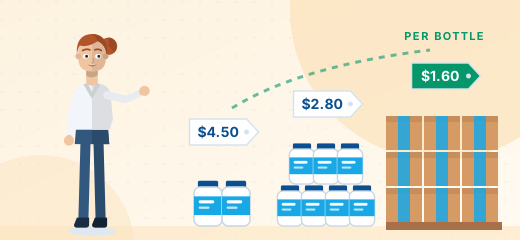
A contract manufacturer spends roughly the same fixed money on every batch, whatever its size: a day of line changeover and cleaning, identity tests on every ingredient lot, a finished-product certificate of analysis, batch records and reserve samples. Spread over 50,000 capsules that overhead is several dollars a bottle; over 500,000 it is cents. That is why small requests often get no quotes at all, and why the per-bottle price of a capsule product roughly halves between a 1,500-bottle run and a 25,000-bottle run.
A request for 50,000 capsules in 800 bottles goes out to a dozen manufacturers and comes back with one quote, or none. The same formula at 500,000 capsules gets five quotes, and every one of them is cheaper per bottle. New brands read that as manufacturers being difficult. It is arithmetic, and once you see the numbers behind it you can use them.
- Every batch carries the same fixed work whether it makes 800 bottles or 8,000: changeover, cleaning, ingredient identity tests, a finished-product COA, batch records and reserve samples.
- On a small run that fixed work costs more than the production itself, so the quote looks high and the manufacturer often does not send one.
- Per-bottle prices for capsule products roughly halve between a 1,500-bottle run and a 25,000-bottle run.
- Most manufacturers get comfortable somewhere around 2,500 to 5,000 bottles of capsules or tablets, roughly 200,000 units and up.
- If you cannot order at that size yet, there are ways to make a smaller request worth quoting. They are at the end.
What it costs just to open the doors
Before a manufacturer can quote anything, they are already paying for a building, machines, certifications and people. None of those costs care how many bottles you ordered. They are paid by the month, and they have to be recovered from every hour the line runs.
| Cost | Rough size | What it covers |
|---|---|---|
| Facility | $9 to $14 per sq ft per year, before build-out | U.S. industrial space averaged about $10 a square foot in 2026, and units under 10,000 sq ft cost roughly a third more. A cGMP plant then adds sealed rooms, HVAC, dust control and a lab on top of the lease. |
| Encapsulation line | $40,000 to $250,000+ | Bench-scale encapsulators start under $40,000; an automatic filler runs 40,000 to 200,000+ capsules an hour and a full encapsulation-to-bottling line is on the order of $250,000. |
| Tablet press | $15,000 to $500,000 | Mid-range rotary presses run 40,000 to 120,000 tablets an hour; high-speed presses from European makers can exceed $250,000 to $500,000, plus punch tooling that wears out. |
| Bottling and packaging line | $250,000 to $500,000+ | Unscrambler, filler, capper, induction sealer, labeler, and the people to run them. |
| GMP certification | Ongoing | An FDA-registered facility must follow 21 CFR Part 111. Third-party GMP certification (NSF, UL and others) takes 4 to 18 months to earn and at least one audit a year to keep, up to four in a bad year. |
| People | $26 to $32 an hour before benefits | Federal wage data puts production workers near $27 an hour, blending machine setters around $32, and quality inspectors and lab technicians around $28 to $30. A line needs several of each. |
Add it up and a modest cGMP plant is carrying tens of thousands of dollars a month before a single order arrives. The only way to pay for it is to keep the machines running on orders that are worth running.
What every batch costs before the first capsule
This is the part most buyers never see. When your order is scheduled, a set of costs lands on it that are the same whether the run is 50,000 capsules or 5 million. Federal cGMP rules require most of them; the rest are just how a line works.
- Changeover and cleaning. The previous product has to come off the line and every contact part cleaned, dried, reassembled and signed off. Swapping a capsule size takes under 30 minutes; a full clean-down and parts change on an automatic filler can take a day.
- Identity testing on every ingredient lot. 21 CFR Part 111 requires at least one identity test on each lot of each dietary ingredient received. A six-ingredient formula means six tests before blending starts.
- Finished-product testing. A certificate of analysis covering identity, potency and microbial limits runs about $500 to $1,500 per batch, and a heavy-metals panel adds $200 to $500.
- Paperwork. A master manufacturing record for the formula, a batch production record for the run, quality-control review and sign-off at each step, and reserve samples held for two years.
- Materials that come in fixed sizes. Ingredients ship in 25 kg drums, bottles and lids by the case or pallet, labels at print minimums. A small run leaves opened drums and half-cases behind.
The math on a 50,000-capsule order
Take that $2,000 of fixed work and an automatic filler running 40,000 capsules an hour. Now look at what happens as the order grows. The fixed cost does not change. The bottles it is spread across do.
| Order size | Bottles (60 count) | Line time actually filling | Fixed cost per bottle |
|---|---|---|---|
| 50,000 capsules | 833 | About 75 minutes | $2.40 |
| 100,000 capsules | 1,667 | 2.5 hours | $1.20 |
| 250,000 capsules | 4,167 | About 6 hours | $0.48 |
| 500,000 capsules | 8,333 | 12.5 hours | $0.24 |
| 1,000,000 capsules | 16,667 | 25 hours | $0.12 |
Read the 50,000 row again. The manufacturer gives up a day of line time to changeover and cleaning in order to run the machine for 75 minutes, and every bottle carries $2.40 of overhead before ingredients, capsules, bottles, labels or margin. At 500,000 capsules the same day of prep supports a run that fills the line for a shift and a half, and the overhead is 24 cents.
Ingredients follow the same pattern. A 500 mg capsule at 50,000 units needs 25 kg of formula, which sounds like one drum until you remember a blend has several ingredients. The manufacturer opens a drum of each, uses a fraction, and either warehouses the rest or charges you for it. At 500,000 units the drums get used.
Why small requests get no quotes
Quoting is not free either. A serious quote means a formulator reads your spec, checks every ingredient for availability and price, works out overages and capsule fill, and a salesperson writes it up. Call it two hours of skilled time. On an order that will earn the manufacturer a few hundred dollars of margin, those two hours are a large share of it, and there is a real chance the buyer chooses someone else anyway.
Then there is the calendar. A line day given to an 833-bottle run is a line day not given to an 8,000-bottle run. When a manufacturer has both on the desk, the small one waits, and if the schedule is full it never gets a slot at all. That is not a judgment about your brand. It is the same reason a freight company would rather fill a truck than send it out a quarter full.
So the small request sits, or comes back with one quote at a per-bottle price that looks unreasonable next to the numbers in the guides. The quote is not padded. It is the fixed work divided by too few bottles.
What counts as big enough, by format
Minimums vary by manufacturer, formula and equipment, but the pattern is consistent. Two-piece capsules and tablets are the most flexible, powders and stick packs sit in the middle, and gummies, softgels and liquids need the largest runs because the equipment, tooling and cleaning are heavier.
| Format | Where most manufacturers get comfortable | Notes |
|---|---|---|
| Capsules | 2,500 to 5,000 bottles, roughly 100,000 to 300,000 capsules | Some quote from 1,500 bottles; below that many will not quote at all. |
| Tablets | Similar to capsules, often a little higher | Tooling and compression setup add fixed time to every run. |
| Powders | 1,000 to 5,000 units | Tubs, scoops and flavor systems have their own minimums. |
| Softgels | Higher, with tooling | Custom shapes and colors mean molds and long cleaning. |
| Gummies | Highest of the common formats | Cooking, depositing and drying lines take the longest to change over. |
One published manufacturer benchmark puts it plainly: a 10,000-bottle batch can cost 20 to 35 percent more per bottle than a 50,000-bottle batch of the same product. Another shows capsule pricing that roughly halves between a 1,500-bottle minimum and a 25,000-bottle run. The exact figures move with ingredients and market conditions; the shape of the curve does not.
What you save by ordering bigger
Here is that curve in per-bottle terms for a typical capsule product, from a published cost guide. Your ingredients will shift the numbers up or down, but the drop from the first row to the last is what a bigger order buys you.
| Order size | Cost per bottle | Total |
|---|---|---|
| 1,500 bottles | $3.50 to $4.50 | $5,250 to $6,750 |
| 5,000 bottles | $2.50 to $3.50 | $12,500 to $17,500 |
| 10,000 bottles | $2.00 to $3.00 | $20,000 to $30,000 |
| 25,000 bottles | $1.50 to $2.50 | $37,500 to $62,500 |
Notice what the table does not say. The 25,000-bottle run costs five to ten times as much in total, so ordering bigger is not free money. It is a lower price per bottle, more manufacturers willing to quote, and a stronger negotiating position, in exchange for more capital up front and more inventory to sell. The right size is the biggest run you can sell through in a reasonable time, not the biggest run you can finance.
How to get quotes when you are still small
Most brands cannot start at 500,000 capsules, and they should not. What you can do is make a smaller request cost the manufacturer less to quote and less to run. Every item below removes fixed work or wasted material, which is exactly what makes a small order unattractive.
- Launch one product at a real quantity, not six products at small ones. Six small runs pay the batch overhead six times. One product at 5,000 bottles pays it once and lands at a far better price.
- Keep variations to a minimum. Every count size, flavor or bottle color is a separate changeover. Two SKUs of one formula is fine; five is five cleanings.
- Use stock capsules, bottles and lids. A 00 clear capsule and a 150 cc white bottle are on the shelf. A custom color is a special order with its own minimum.
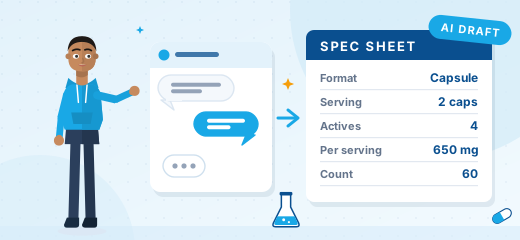
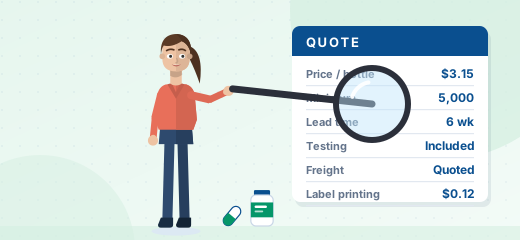
- Send a complete request. A spec with ingredients and amounts, count per bottle, total bottles, who prints the labels and where the order ships lets a manufacturer quote in twenty minutes instead of two hours of back and forth. Manufacturers quote the easy ones first.
- Be flexible on timing. Lines have gaps between big runs. A buyer who can take a slot whenever one opens is worth more to a scheduler than one who needs a fixed week.
- Consider private label for the first run. A stock formula the manufacturer already makes shares its batch overhead with other brands, which is why private label minimums are so much lower.
- State a target price. It tells the manufacturer whether the request is worth the two hours before they spend them.
When you request quotes on SupplementQuotes, the request already asks for the things above: the formula, counts and bottles, who prints the labels, and the ship-to address. Manufacturers see all of it on one card before they decide whether to quote, so the ones who can do your size do, and the ones who cannot do not waste your time or theirs.
Sources: TenantBase, industrial lease rates 2026 · Crestmont Capital, supplement equipment costs · SupplySide Journal, capsule filling throughput and changeover · Hanyoo, tablet press pricing · U.S. Bureau of Labor Statistics, production and lab wages (May 2023) · FDA, dietary supplement cGMP small entity compliance guide · NSF/ANSI 455-2 GMP certification · InventoryReady, supplement cost guide · Runxin Biotechnology, OEM pricing and MOQ · Lacsa Laboratorios, MOQs by format. Figures are published ranges and illustrative estimates, not quotes; your manufacturer’s numbers will differ.
Submit your product once and receive competing quotes from verified supplement manufacturers, free for brands and NDA-protected.