Vitamin Manufacturing Quotes: What’s In One and What It Costs
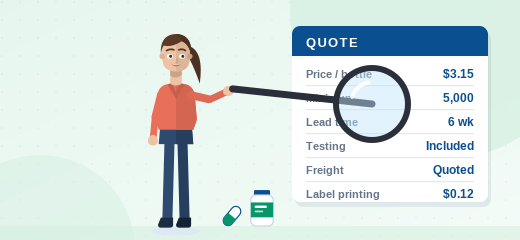
A complete vitamin manufacturing quote states the price per unit tied to a bottle count and formula, the minimum order quantity, lead time, what testing is included, packaging scope, label printing and payment terms; a single number in an email is an estimate, not a quote. For standard vitamin capsules at moderate volumes most brands land between $2 and $5 per bottle before packaging extras, and two products that look identical can quote 40% apart depending on ingredient forms, bottle count, order volume, certifications and testing depth. Nutraceutical quotes work the same way: “nutraceutical” is not a legal category of its own in the US, and most nutraceuticals are sold as dietary supplements.
A vitamin manufacturing quote looks simple on the surface: a price per bottle and a delivery date. But the difference between a quote you can trust and one that falls apart in production is everything the number is built on, from the spec and the sourcing to the testing and the terms. This guide walks through exactly what a real quote includes, what moves the price, how the process runs, and how to request one that comes back accurate the first time. It applies the same way to nutraceutical products.
What a Vitamin Manufacturing Quote Should Include
A complete quote from a serious manufacturer is more than a unit price. Before you compare numbers, make sure every quote on your desk covers the same nine things:
- Price per unit: usually per bottle, tied to a specific count (60 ct, 90 ct, 120 ct) and formula, ideally at two or three volume tiers so you can see the price curve, not one point on it
- Minimum order quantity (MOQ): per SKU and per bottle count, not just an overall number
- Formulation basis: your formula, or the manufacturer’s development work, and who owns the formula afterward (get this in writing)
- Raw material sourcing: standard or branded ingredients, domestic or imported, and what that does to lead time
- Lead time: from deposit to shipment, including ingredient sourcing time
- What testing might be included: identity, potency, heavy metals, micro; and whether a Certificate of Analysis comes with every lot
- Packaging scope: bottle, lid, desiccant, neck band, label application, case pack and pallets
- Label printing: who prints, and at what cost if the manufacturer does
- Payment terms: deposit percentage, balance timing, and what happens if final unit counts differ from the order
Nutraceutical, Supplement, Vitamin: Same Rules, Different Word
In the US, “nutraceutical” is not a legal category of its own. Most nutraceuticals are sold as dietary supplements, so they fall under DSHEA and FDA cGMP requirements (21 CFR Part 111), not drug rules. The word signals positioning more than category: functional, science-forward products such as nootropics, joint support and sports recovery formulas. Manufacturers quoting these products price the same fundamentals as any vitamin, with extra weight on ingredient verification and claims support, so everything in this guide applies to a nutraceutical quote too.
What drives the price of a vitamin manufacturing quote?
Two vitamin products that look identical on a shelf can be quoted 40% apart. The gap almost always comes from one of these drivers:
| Cost driver | Why it moves the price |
|---|---|
| Active ingredients & forms | Chelated minerals, branded ingredients, and high-dose actives cost multiples of commodity forms (e.g. magnesium glycinate vs. oxide) |
| Number of ingredients | Each additional active adds sourcing, testing, and blending complexity |
| Bottle count & fill | A 120-count bottle is not 2x a 60-count price: filling, capsules, and packaging scale differently |
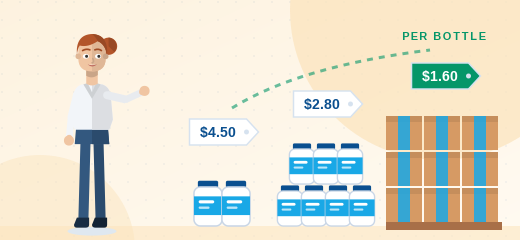
| Order volume | Price breaks commonly land at 2,500 / 5,000 / 10,000 units; the jump between tiers can outweigh small formula changes |
| Certifications | Organic, non-GMO, NSF, or kosher runs restrict sourcing and add audit cost |
| Testing depth | Third-party finished-product testing costs more than in-house testing alone, and it is worth it |
As a rough orientation for standard vitamin capsules at moderate volumes, most brands land somewhere between $2 and $5 per bottle before packaging extras, but treat any range you read online (including this one) as a starting point, not a benchmark. Your formula is the price. What a bottle costs at each order size, and what goes into it, is in how much it costs to manufacture supplements.
How Long Should a Quote Take?
The old way of getting quotes is genuinely slow. Cold-emailing manufacturers one at a time typically means days to weeks per reply, and many never respond to small brands at all. A reasonable standard to hold: an initial quote or a clarifying question within 48 to 72 hours of a complete spec. If a manufacturer takes two weeks to quote, expect production communication at the same speed.
How the Quote Process Actually Runs
| Step | What happens | Typical time |
|---|---|---|
| 1. Spec submission | You provide formula, counts, volumes, packaging, certifications | Day 0 |
| 2. NDA | Confidentiality before formula details circulate | Day 0 to 1 |
| 3. Sourcing check | Manufacturer prices raw materials against the current market | 1 to 3 days |
| 4. Quote delivered | Tiered pricing, lead time, terms | Within about a week; about 48 hours on a marketplace |
| 5. Negotiation | Counter-offers on price, volumes, terms | Days |
| 6. PO + deposit | Purchase order issued; deposit (commonly 50%) starts sourcing | Day 1 after acceptance |
| 7. Production + release | Manufacture, test, approve label, ship | 6 to 12+ weeks |
How to Request a Quote That Comes Back Accurate
Vague requests get vague quotes. Manufacturers price what they can see, and pad what they cannot. Send every manufacturer the same complete spec:
- Every active ingredient with its amount per serving and preferred form
- Serving size, servings per container, and each bottle count you want quoted
- Quantity per bottle count, and ask where the next price break sits
- Packaging preferences: bottle material and color, lid type, desiccant, label size
- Certifications you need on this run (not someday: this run)
- Whether you have label artwork ready or need design help
- Your target price per bottle, if you have one: it saves a negotiation round
What are the red flags in a vitamin or nutraceutical quote?
Buyers comparing multiple facilities should treat these as warnings, not quirks:
- A single blended price with no line items: you cannot tell what is and is not included
- No commitment to lot-level Certificates of Analysis
- Vague answers on where actives are sourced, or resistance to disclosing ingredient forms
- 100% payment upfront from a facility you have not worked with
- A quote that undercuts every competitor by 30% or more: the savings usually come out of testing or ingredient quality
- No mention of label review before printing: compliant facilities always check artwork against the formula
How do you compare vitamin manufacturing quotes?
When quotes arrive, normalize before you compare: same formula and ingredient forms, same bottle count and volumes, same certifications, testing included, label costs stated, freight terms clear. The cheapest headline number frequently becomes the most expensive order once excluded line items land on the invoice. Then weigh what is not in the price: responsiveness during quoting is the best preview you will get of responsiveness during production.
This is the problem SupplementQuotes® was built to remove. You describe your vitamin product once (formula, counts, packaging, certifications) and verified, NDA-protected manufacturers submit competing quotes on that same spec. Pricing, lead times, and terms sit side by side, most quotes arrive within about 48 hours, and the negotiation, label approval, and payments all run in one place. Getting a vitamin manufacturing quote should be the easy part of building your brand.
Submit your product once and receive competing quotes from verified supplement manufacturers, free for brands and NDA-protected.